Wave types
- Transverse waves are like ripples or ocean waves. The wave vibration direction is perdendicular to the wave motion direction.
- Longitudinal waves are like shockwaves through a solid. The wave vibration direction is parallel to the wave motion direction.
Wavelength and frequency
The wavelength \lambda is the distance measured along one period T of the wave, in meters. The period is measured in seconds.
The frequency f is the number of wavelengths that pass a fixed point per second. f = \frac{1}{T}.
The velocity of a wave is given by the product of the wavelength and frequency, and is measured in \m\s^{-1}.
Wave function
The general wave function is given by:
The first term in the parentheses gives the frequency of the wave, and the second term gives the wavelength and somehow represents the phase. Note that the first term is relative to time, and the second is relative to distance.
Natural frequency
The natural period of a pendulum is given by the length L of the pendulum and the gravitational constant g. This only applies if the amplitude of the swing \theta is less than 10°.
The natural period of a mass on a spring is given by the mass m and the spring constant k.
Doppler effect
Where f' is the observed frequency, f is the actual frequency, v is the velocity of the wave, and v_s is the relative velocity of the source:
Properties
Energy
The energy of a wave is proportional to the square of the amplitude.
If the amplitude decreases, the energy increases, and vice versa. This is why ocean waves get so much taller in shallow water.
Intensity
The intensity of a wave is a measure of the power per unit area, given as watts per square meter (\W\m^{-2}). S gives the area.
A perfect laser is a collimated wave, with equal intensity along the full length of the beam. For non-collimated waves, intensity decreases with distance.
Phase
Particles in a wavey medium are in-phase if they’re separated by one wavelength, and are out-of-phase if separated by half a wavelength.
Velocity of an EM wave
The speed of light in a vacuum is approximately 3\e{8} \m\s^{-1}. All electromagnetic waves travel at the speed of light in a vacuum. Any oscillating charge generates an EM wave.
Higher-frequency EM waves have smaller wavelengths but higher energy (because energy is proportional to frequency). h is the Planck constant.
Velocity of a wave on a string
The velocity v of a wave on a string of a given tension T (in newtons) and linear density \mu (mass per unit length) is:
Interference
The amplitude of two waves are added as they overlap (“superposition”). Interference is constructive, destructive, or partial in either flavour.
Standing waves
A standing wave is created by the superposition of two waves of the same frequency but opposite directions, causing a resultant wave with zero apparent velocity that oscillates up and down. This is easily created via reflection.
No energy is transferred by a standing wave, because the same energy is carried in opposite directions, cancelling out.
Reflection
Waves are reflected off boundaries. Soft boundaries (free perpendicular movement, or sliding along a pole) have no phase change, and hard boundaries (fixed end) have a phase inversion (180° phase change).
Nodes and anti-nodes
Static points in a standing wave are nodes, and points of greatest movement are anti-nodes. The distance that bridges three nodes is exactly one wavelength.
For a transverse wave in a guitar string, a node is formed at both ends, because both ends are fixed. For a longitudinal wave in an air column, an antinode is formed at the open ends, because the medium isn’t fixed. A node would be formed at a closed end.
Harmonics
Harmonics are stable states for standing waves.
The first harmonic is called the fundamental frequency of a medium (or string) and is exactly half a wavelength long, so half a wavelength covers the length of the medium. Each subsequent harmonic (second, third, etc) increases the frequency to fit another half a wavelength of wave inside the same length of medium.
Beat frequency
The beat frequency is equal to the difference between the frequencies of the two interfering waves.
Diffraction
Diffraction is the spreading out of a wave as it passes through a gap or past an obstacle. This can be seen in ocean waves that bend around a rocky point or spread out from a gap in a breakwater.
The smaller the gap, the greater the spread. If the gap is large, the wave will only bend outward near the edges.
Huygen’s principle
Each point on a wavefront can be considered to be a source of wave energy, with the wavefront itself generated from the constructive interference of this infinite series of waves.
Young’s interference
The double-slit experiment. Two nearby sources of the same frequency and phase will generate a characteristic interference pattern.
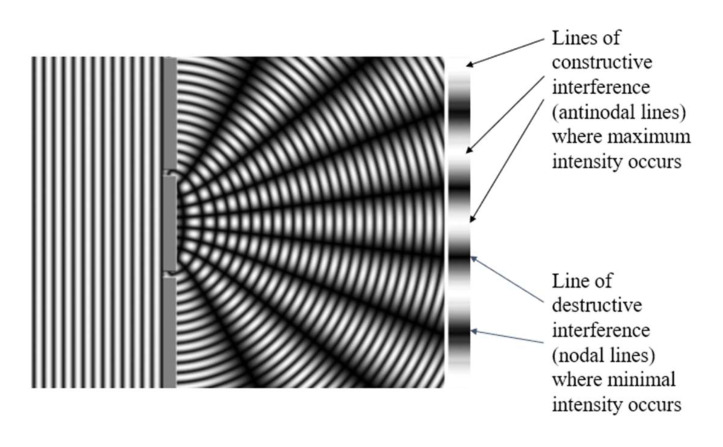
For any point on the screen, the path difference \Delta S is the difference between the lengths l_1 and l_2 from that point to each slit, and is given by the distance d between the slits and the angle \theta between the central axis and that point:
A bright spot on the screen (antinode, constructive interference) will have a path difference that is an integer multiple m of the wavelength. The point of intersection between the central axis and the screen is always an antinode.
A dark spot (node, destructive interference) will have a path difference that is an integer multiple m of the wavelength plus half a wavelength.
Increasing the distance d will reduce the angle \theta.