Physics

Uncertainties

Uncertainties should be expressed to one significant figure, and the measurement value should be given to the same number of decimal places. For example, 2.058 \pm 0.027\m should instead be given as 2.06 \pm 0.03\m.

Notation for uncertainties

When writing an absolute uncertainty, the unit comes after the uncertainty:

5.2 \pm 0.1\m

When writing a percentage uncertainty, the unit comes after the value:

5.2\m \pm 1\%

Addition and subtraction of uncertainties

When adding or subtracting two measurements, always add the absolute uncertainties.

Multiplication and division of uncertainties

When multiplying or dividing two measurements, always add the percentage uncertainties.

When squaring a measurement, double the uncertainty. When taking the square root, halve the uncertainty.

Relationships

When a = k \times b, we say that a is directly proportional to b, or:

a \propto f(b)

The value k is the proportionality constant. A graph mapping a to f(b) will have a gradient of k and will pass through (0, 0) (with f(x) representing the type of relationship, such as x^2 or \frac{1}{x}).

  • If f(x) = x, then a is directly proportional to b. The graph is a straight line.
  • If f(x) = \frac{1}{x}, then a is inversely proportional to b. The graph is a rectangular hyperbola.
  • If f(x) = x^2, then a is proportional to b squared. The graph is a parabola.

Power relationships

A power relation between the variables a and b with a constant power n takes the form:

a = kb^n

This can be graphed using a logarithmic scale on both axes to get a linear graph. If we take logarithms of each side and expand, we get:

\log a = n \log b + \log k

If we compare this to the line equation y = mx + c, we can see that the gradient is given by the power n, and the y-intercept by \log k.

Kinematics

Kinematics concerns values derived from the positions of objects and time.

Types of quantity

A scalar quantity has a magnitude, but no direction. A scalar s is notated as a plain letter.

A vector quantity has both a magnitude and a direction (in any number of dimensions). A vector F is notated as \vec{F}, having an arrow above.

Motion

Position is given as either:

  • A scalar d (distance travelled), the distance between two points.
  • A vector \vec{d} (displacement), the distance and direction of a point from a starting point. This can be different from distance if the direction of motion changes in-between points.

Rate of change of position is given as either:

  • A scalar v (speed), the distance travelled in a unit of time (v = \frac{\Delta d}{\Delta t}).
  • A vector \vec{v} (velocity), the distance and direction travelled in a unit of time.

Second-degree rate of change of position is given as:

  • A vector \vec{a} only (acceleration), the change in velocity in a unit of time (a = \frac{\Delta v}{\Delta t}). The direction of acceleration is equal to the direction of the force producing the acceleration. Notice that we can only find the change in velocity, not the velocity outright.

To recap:

  • a change in velocity (\Delta v) is calculated from a constant acceleration applied over a duration (at).
  • an average acceleration (a) is calculated from a change in velocity over a duration (\frac{\Delta v}{t}).
  • a change in distance (\Delta d) is calculated from a constant velocity applied over a duration (vt).
  • an average velocity (v) is calculated from a change in distance over a duration (\frac{\Delta d}{t}).

Equations of motion

These equations apply only to motion in a straight line with uniform acceleration. v_i is initial velocity, v_f final velocity, and d total displacement.

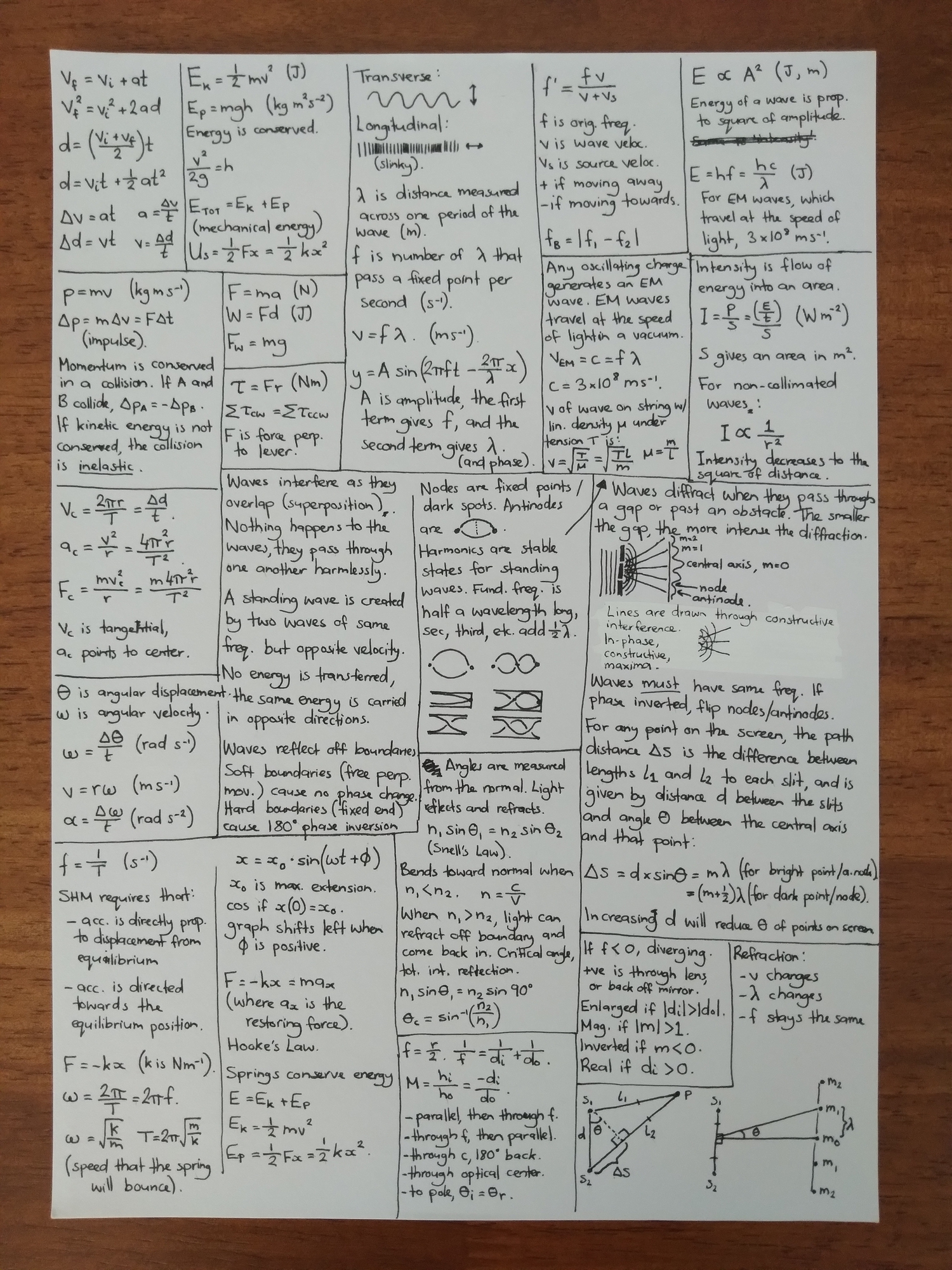
  • v_f = v_i + at
    This is because at is equal to the change in velocity.
  • v_f^2 = v_i^2 + 2ad
    I don’t understand this one.
  • d = \left( \frac{v_f + v_i}{2} \right) t
    This is because we multiply average velocity by time elapsed.
  • d = v_i t + \frac{1}{2}at^2
    This is an expansion of the previous equation, after replacing v_f with v_i + at as per the first equation. It makes sense geometrically, where graphing v over t gives a straight line.

Force

Force (F) is measured in newtons (N), which are equivalent to \kg\m\s^{-2}.

Newton’s first law states that when the net force on a body is zero, the acceleration of the body will also be zero. This is implied by the second law.

Newton’s second law states that the net force on a body is equal to the body’s acceleration multiplied by its mass, which is equal to the rate at which the body’s momentum is changing with time:

\vec{F} = m\vec{a} \tag{mass, acceleration}

Newton’s second law states that if two bodies exert forces on one other, then these forces have the same magnitude but opposite directions.

Energy

Energy (E) is measured in joules (J) or newton-meters, which are equivalent to \kg\m^2\s^{-2}.

Kinetic energy (E_k) is energy posessed from speed (not velocity), or energy required to attain a speed, and is measured in joules. It is given by:

E_k = \frac{1}{2}mv^2 \tag{mass, speed}

Gravitational potential energy (E_p) is energy posessed from height, or energy required to attain a height, and is measured in joules. It is given by:

E_p = mgh \tag{mass, grav. force, height}

Work

Work (W) is done when energy is transformed from one form to another (measured in joules).

The work done when using a force F to move an object by a distance d is given by:

W = F \times d \tag{force, distance}

For a force that varies over time, the work done is given by the total area beneath a graph of force vs distance, which can be calculated via definite integration.

Power

Power (P) is measured in watts (W). It is the rate of change of work, measuring the rate in which work is done, and is given by:

P = \frac{W}{t}

Momentum

Momentum (p) is measured in \kg\m\s^{-1} or newton-seconds. It is given by:

\vec{p} = m \vec{v} \tag{mass, velocity}

Impulse

Change in momentum is called the impulse of a force, and is given by:

\Delta \vec{p} = m \Delta \vec{v} = \vec{F} \Delta t

This can be found by rearranging F = m\frac{\Delta v}{\Delta t}.

Conservation of momentum

Momentum is always conserved following an explosion or collision, but kinetic energy is not (it is spent to change velocity). Collisions which involve a loss of energy are called inelastic collisions. Collisions which do not involve a loss of energy are called elastic collisions.

If objects A and B collide, the change in momentum of one is equal and opposite to the change in momentum of the other:

\Delta\vec{p}_A = -\Delta\vec{p}_B

A collision of this type is called a glancing collision.

Conservation of momentum in two dimensions

Find the momentum of each object as a vector, and then find the sum the vectors using a vector diagram.

Subtracting a vector is the same as adding the opposite vector (flip both the magnitude and direction):

\vec{A} - \vec{B} = \vec{A} + -\vec{B}

Center of mass

The center of mass of an object can be found by suspending the object from several points in turn, and finding the intersection between the lines drawn downwards from each point of suspension. This is because the center of mass will always lie directly beneath a point of suspension.

The center of mass of a two particle system is the point that would be the center of mass if both particles were joined by a weightless bar.

Two objects in space will orbit around their common center of mass.

In any situation where momentum is conserved, the velocity of the center of mass remains constant:

\vec{v}_{total} = \frac{\vec{p}_{total}}{m_{total}}

The distance r of the center of mass of n objects on a line from an arbitrary point will be:

r = \frac{\sum_{i=1}^n m_i r_i}{\sum_{i=1}^n m}